Search is where the App Store sells. Apple Ads says "almost 65% of downloads happen directly after a search" (2022 worldwide data). In 2026, over 850 million people visit the store every week (Apple Ads, 2026). And Sensor Tower counted about 560,000 new apps in the first half of 2026 alone (9to5Mac, July 20, 2026).
A new app ranked #80 for "budget" gets almost nothing from it. At #6 for "budget app for couples," it gets real, well-qualified installs. That's the case for long-tail App Store keywords. But which phrases, how long do you wait, and when have you earned the big term?
This post covers the sequencing only. It assumes you've already built a scored list; for that, start with finding and scoring keywords. Here, the question is the order you attack it in.
Key Takeaways
- Apple's 2026 ranking paper found its biggest gains on tail queries, where text fit fills in for thin behavior data (Apple Machine Learning Research, 2026).
- In our 18-search US snapshot, positions 6–10 held a median 757 ratings on long-tail phrases vs 17,970 on head terms.
- Read ranks after about four weeks on iOS; climb only when four gates pass.
- After July 2026, prune loosely relevant phrases.
What is the keyword ladder, and why start with long-tail keywords?
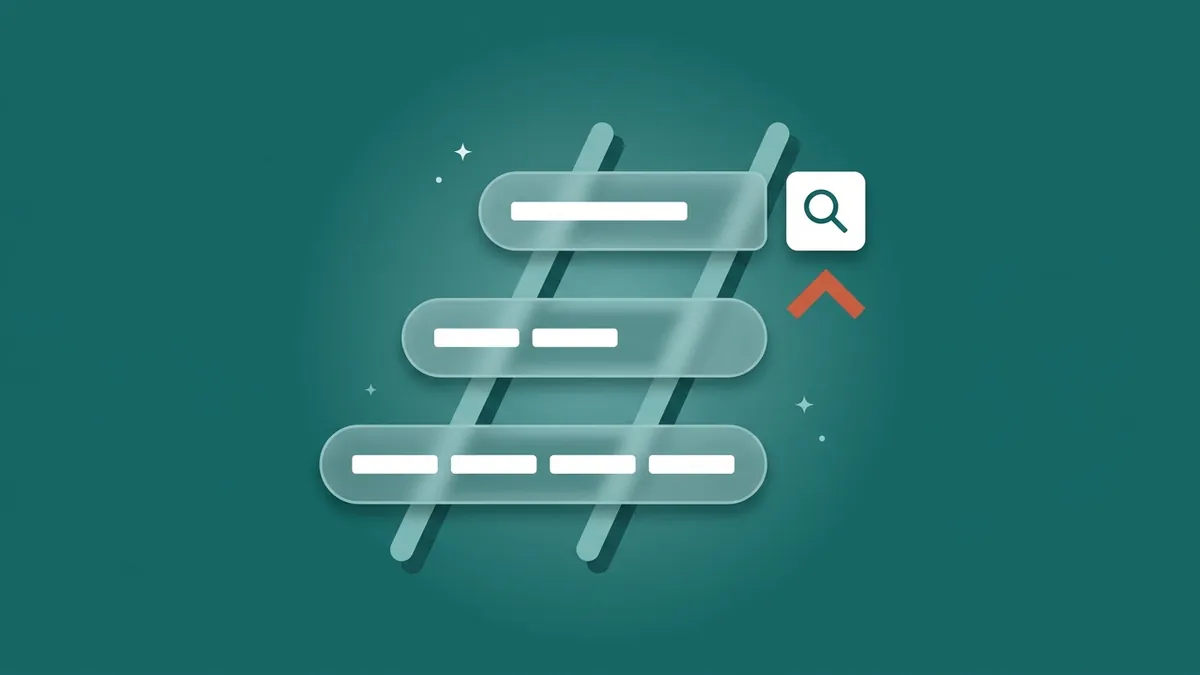
The keyword ladder is a sequencing strategy: win the top 10 for specific long-tail phrases first, then climb to mid-tail and head terms as downloads and ratings build. Apple's research shows why the bottom rung is winnable. In a worldwide test, LLM relevance labels lifted App Store conversion 0.24%, "with the most substantial performance gains occurring in tail queries" (Apple Machine Learning Research, February 2026).
The paper describes a ranker that blends "behavioral relevance (results users tend to click or download)" with "textual relevance (a result's semantic fit to the query)." On tail queries, the text labels "provide a robust signal in the absence of reliable behavioral relevance labels." A rare query has little click and download history, which leaves your metadata's fit carrying more weight.
Apple's public page agrees: results use "text relevance" and "user behavior (downloads, ratings and reviews, and more)" (Apple Developer, App Store search). We cover the two engines Apple ranks on elsewhere. The upshot: a new app can crack a long-tail keyword top 10 on fit, while head terms reward installs and ratings.
The keyword ladder: three rungs, three ways to win
Many of the biggest terms are brands anyway. In AppTweak's 2024 US study, more than 97% of keywords with volume above 75 were brand names (AppTweak, November 2024). Your own brand is off the ladder: you defend it, you don't climb it.
Specific keywords "can help you improve the rate of ad taps to installs," says Apple (Apple Ads, Keywords best practices, 2025); for organic search, that's consensus. In 2026, AppDrift's vendor model averaged 70.1 out of 100 for one-word iOS terms and 53.4 for three-word phrases across 862 scored checks, with its own caveat: "adding words does not itself make a keyword easier" (AppDrift, updated September 2026).
Does winning long-tail phrases lift your head-term rank? Not automatically. Apple defines behavioral relevance per query, so a head term's own click and download history has to be earned on that term. "Stack long-tail wins and head terms follow" is consensus, not a documented mechanism. Here's how each assumption grades on our evidence scale.
| Ladder assumption | Grade | Basis |
|---|---|---|
| Apple ranks on text relevance plus user behavior | Confirmed | Apple Developer, App Store search |
| Text-relevance labels help most on tail queries | Confirmed | Apple Machine Learning Research, 2026 |
| Positions 6–10 are held by far smaller apps on long-tail terms | Tested | Our 18-search US snapshot, September 28, 2026 |
| Specific keywords convert better | Confirmed ads · Consensus organic | Apple Ads, 2025 |
| Long-tail wins lift head-term rank | Consensus | No public test |
| Loosely relevant long-tail lost ground in July 2026 | Consensus | Observed by Phiture and ASO World; not confirmed by Apple |
How do you build the rungs for your app?
Sort your scored list into rungs by how strong each term's current top 10 is, not by word count. In our September 2026 snapshot, we classed the two-word "habit tracker" as a head term, and its top 10 bore that out: every app had at least 2,434 ratings. A rung-1 phrase is one your app answers exactly, where the top 10 includes apps no bigger than yours.
ASO Agency framework. The rating-count column comes from our snapshot in the gap section below; the popularity column relies on vendor reports, not Apple.
| Rung | Typical shape | Popularity in API-based tools | Positions 6–10 (our snapshot) | What wins it | Target |
|---|---|---|---|---|---|
| 1 · Long-tail | 3+ words, or a niche 2-word term | Often the floor of 5 | Median 757 ratings | Exact text fit | Top 10, then top 5 |
| 2 · Mid-tail | 2-word generic phrase | Visible if it scores 35+ | Median about 8,000 | Text fit plus search conversion | Top 10 |
| 3 · Head | 1–2-word category term | High, visible score | Median about 18,000 | Downloads, ratings, conversion at scale | Top 10 |
| Off-ladder | Your brand, competitor brands | n/a | n/a | Defend your brand in Apple Ads | n/a |
For rung-1 candidates, put three or four core words into the free Keyword Shuffler. It lists every 1- to 4-word ordering (four words give 64 phrases) but shows no volume, difficulty or rank data. Check each against autocomplete and prune hard for fit: a phrase your fields can assemble isn't always one your app answers. See how the keyword field combines words into phrases.
Rungs are also per storefront. A US mid-tail term can be rung 1 in the UK. Most apps end up with a cluster of rung-1 phrases, a few rung-2 targets and at most one head-term bet per storefront.
Since late September 2025, ASO vendors report that Apple's Ads API only returns search popularity for terms scoring 35 or more. Sonar still reports that cutoff as of September 22, 2026 (Sonar, 2026). From September 29, 2025, aso.dev saw US keywords above the floor of 5 drop from 165,875 to 39,254 (aso.dev, 2026). Apple hasn't confirmed either.
A search popularity of 5 doesn't mean nobody searches a phrase. Judge rung-1 demand from autocomplete and Apple Ads search terms.
Last verified against vendor reports: September 28, 2026.
How do you know you've won a rung?
You've won a rung when your target phrases hold the top 10 in that storefront for four weekly checks after ranks settle, and search installs show up. AppTweak says iOS rankings "stabilize around 4 weeks after a new build is uploaded," and new apps get a boost "during the first 7 days" (AppTweak, October 2025). Launch-week ranks flatter you.
Check each rung term weekly in the Keyword Rank Checker. It returns the top 200 in 50 storefronts, without ads or personalization, in Apple's iTunes Search API order: close to, but not exactly, what shoppers see. For the clocks behind the wait, see why iOS ranks need about four weeks to settle.
Demand is harder to see. App Store Connect has no search-term dimension, so iOS keyword data comes from Apple Ads search-term reports, which show "low volume" for any term under 10 impressions a day (Apple Ads Help, 2026). Many rung-1 phrases never clear that bar. For them, autocomplete presence plus a stable top-10 rank is enough.
Installs need one correction. Apple's App Store Search source "includes views and downloads from ads that appear in App Store search results" (Apple Help, Acquisition, 2026), so net out Apple Ads installs before you call a lift. Last, confirm no store-wide volatility hit your read window (see the July 2026 section).
How big is the gap between rungs in live search results?
The gap is large, and it's about rating volume, not stars. On September 28, 2026, we pulled the US top 10 for 18 searches in three categories. At positions 6–10, the median app had 757 ratings on long-tail phrases, about 8,000 on mid-tail terms and 17,970 on head terms. Median star averages differed by about 0.1.
The rung gap: median ratings per app, by rung and position
| Rung | Median ratings, #6–10 | Top-10 slots under 1,000 ratings | Median stars, #6–10 (rated apps) |
|---|---|---|---|
| Head (3 searches) | 17,970 | 0 of 30 | 4.75 |
| Mid-tail (6) | 7,966 | 9 of 60 | 4.76 |
| Long-tail (9) | 757 | 30 of 90 | 4.66 |
Two patterns stand out. A third of long-tail top-10 slots went to apps with under 1,000 ratings, and 21 of 90 to apps with under 100; on head terms, none did. Yet the top three on long-tail phrases still belonged mostly to big apps, with a median of 17,669 ratings. The opening sits at positions 6–10.
On September 28, 2026, we queried Apple's public iTunes Search API, the source behind our Keyword Rank Checker, for 18 US searches and logged rating count and average at positions 1–10 (raw data).
- Head: budget, meditation, habit tracker.
- Mid-tail: budget planner, expense tracker, sleep sounds, breathing exercises, routine planner, goal tracker.
- Long-tail: budget app for couples, envelope budget app, paycheck budget planner, meditation for beginners, sleep stories for kids, breathwork for anxiety, habit tracker for adhd, morning routine checklist, daily habit tracker widget.
It's a snapshot, not a benchmark. Size your own next rung the same way in the Rank Checker.
When should you climb to the next rung?
Climb when four gates pass at once. You hold the current rung, it converts, your ratings are within reach of the apps at positions 6–10 on the next term, and the next term fits your app. In our September 2026 snapshot, the median app at positions 6–10 had about 10 times more ratings on mid-tail terms than on long-tail ones. That's why Gate 3 usually opens last.
These are ASO Agency working heuristics: starting points to tune by category, not Apple thresholds. The last column gives our reason for each.
| Gate | Check, and where | Working heuristic | Why this number |
|---|---|---|---|
| 1 · Hold | Share of current-rung terms in the top 10 (Rank Checker, weekly, per storefront) | About two-thirds, for 4 weekly checks after the settle | One stubborn phrase shouldn't block you; under half means the fit isn't there. |
| 2 · Convert | Search installs and conversion since you won the rung (App Store Connect net of Apple Ads; Play Console) | Flat or rising | Climbing takes characters from converting phrases; they must be steady to read the new term. |
| 3 · Proof gap | Your rating count and average vs the median at positions 6–10 on the next term (Rank Checker) | Count at least a third of their median; average within about 0.2 stars | In our snapshot, a third of the median fell below the 6–10 band's bottom quartile; only 4 of 29 rated mid-tail apps there sat 0.2+ stars under the median. |
| 4 · Fit | Does the term describe your app's core job? (Your judgment plus an exact-match Apple Ads test) | Gets impressions at a normal bid | Apple won't show an irrelevant app's ad at any price. |
Why positions 6–10 and not #1? You're trying to get into the top 10, so compare yourself with the apps you'd displace, not the leader.
Gate 4 leans on Apple Ads. Apple says an app that isn't relevant to a search "won't be displayed," "regardless of how much you may be willing to pay" (Apple Ads Help, 2026). No impressions on an exact-match ad at a reasonable bid is a warning, though bid and budget can cause the same silence; we read it as a signal, not proof. Test the next rung in Apple Ads first.
The head word is often already inside your long-tail phrases: "budget" sits in "budget app for couples." That makes graduation a placement move: the word moves from the keyword field into the subtitle or title, which practitioners believe weigh more (Apple doesn't publish field weights). Words combine within a localization, so the phrases that shared it usually keep working. For the title trade-off, see whether a head term earns your title.
Keywords change only with a new app version, so the climb rides your release train. Paid spend can help indirectly. A 2025 study (revised July 2026) found that a large US game developer's global ad shutoff cut organic installs 20–30%, via app store category rankings (Ju, Zhao and Aral, arXiv). That's top charts, not keyword rank.
Falling back is allowed. Our house rule: if you climb, lose the new rung's top 10 within two reads and see search conversion drop, restore the previous placement.
When should you swap a keyword out, and what happens to the rung you leave?
Swap on evidence, not impatience. AppTweak puts the iOS read at about four weeks after a new build, and specialists wait "6 to 8 weeks" between Google Play metadata changes (AppTweak, October 2025). At four weeks a read, iOS allows about 13 readable keyword iterations a year, and every swap spends one.
| Situation | Action (house rule) |
|---|---|
| Before week 4 on iOS, or weeks 6–8 on Play | Don't touch it |
| Rung-1 phrase outside the top 50 after two reads | Replace its unique words, unless they build other phrases you rank for |
| Top 10, but no demand signal after two reads | Keep it only if its words cost no extra characters |
| You've graduated to rung 2 | Keep the shared words. Free only characters used solely by phrases you no longer need |
| Rank lost in a store-wide event | Freeze for one read cycle |
| Rank lost on a term your app only loosely serves | Don't re-add it. Replace it with a higher-intent phrase |
"No demand signal" means no Apple Ads impressions and, on Play, no search-term visitors. And the rung you leave? Words combine within one localization, so a graduated app usually keeps most rung-1 phrases while their words stay indexed somewhere. That's our inference, so confirm it in the Rank Checker after the release.
Change one thing per localization per cycle. Two changes in one release can't be read apart, and at about 13 reads a year, a muddled read costs a month.
What doesn't work?
Repeating a head term across fields and adding competitor names both fail, for reasons our keyword field rules cover. Two more traps:
- Promotional text as a rung. Apple says it "doesn't affect your app's search ranking" (Apple Developer, App Store search).
- Swapping on day five. Neither version ever settles, and you learn nothing.
What did the July 2026 volatility change for long-tail keywords?
Loosely relevant long-tail phrases reportedly lost the most, so prune them rather than re-add them. Phiture reports significant algorithm changes "between July 27 and 28" in the US, Canada, Brazil, China and India, with AppTweak's anomaly score in India at 22.8 against a typical reading below 2 (Phiture, ASO Monthly #121, August 7, 2026). Apple hasn't confirmed any change.
Last verified: Sep 28, 2026.
Phiture's working hypothesis is that "the algorithm is placing greater emphasis on semantic relevance," which it calls unconfirmed. ASO World saw a US spike on July 26–27, with 94,092 apps losing ranked keywords, and wrote that "long-tail keyword footprints disappeared" (ASO World, updated September 1, 2026). Read both vendors as direction, not measurement, and use our 12 checks to diagnose a sudden keyword drop.
Here's the link to the ladder. Apple's February paper puts semantic fit at the center of tail-query ranking. If July pushed further that way, the exposed rankings are phrases your fields can spell but your app doesn't really answer, while tightly fitted rung-1 phrases should be safer. That's our reading, not an Apple statement.
Triage before you rewrite. Phiture suggests you first identify "which keywords experienced the largest declines" and whether CRO or paid acquisition can support them. Apple's LLM-generated App Store Tags, announced at WWDC in June 2025, point the same way: Apple reads meaning, not just strings (TechCrunch, June 2025).
Which long-tail phrases to keep after July 2026
Does the keyword ladder work the same on Google Play?
The sequence transfers, and the readout is better. Play Console has a "Search term" dimension, "the term that the user searched for before navigating to your Store Listing," with visitors and CTR. Google suggests you "review Google Play search terms driving the most visits" (Play Console Help, 2026). You can see whether a rung actually sends traffic.
Relevance on Play uses "metadata (for example, title, description, category) and other signals" (Play Console Help, App discovery and ranking). Long-tail phrases can live as natural sentences in the full description; see our guide to the Google Play title, short and long description.
| App Store | Google Play | |
|---|---|---|
| Rank source | Keyword Rank Checker (free) | Paid ASO platform; Google has no public search API |
| Search-term data | Apple Ads reports; under 10 impressions a day shows "low volume" | Play Console Search term dimension |
| Read interval | About 4 weeks | 6–8 weeks |
| Where phrases live | Name, subtitle, keyword field | Title, short and full description |
Frequently asked questions
What are long-tail keywords on the App Store?
Specific searches, usually three or more words, with lower volume and clearer intent than category terms, such as "budget app for couples." In AppDrift's 2026 vendor model, three-word iOS phrases averaged 53.4 difficulty against 70.1 for single words, though AppDrift warns that adding words doesn't by itself make a keyword easier.
Should a new app target head terms at all?
Rarely as its main bet. In our September 2026 snapshot of 18 US searches, no app in a head-term top 10 had fewer than 1,000 ratings. New iOS apps also get a first-week ranking lift, per AppTweak, so launch week can overstate your reach. Test one head term in Apple Ads before spending title characters on it.
Do long-tail rankings help you rank for head terms?
Indirectly, as far as public evidence shows. Apple lists downloads, ratings and reviews as ranking inputs, and long-tail installs raise all three. But Apple's 2026 ranking paper defines behavioral relevance per query, and no public test shows rank transferring directly from one term to another. Treat the ladder as practitioner consensus, not a confirmed mechanism.
How long should I wait before swapping an App Store keyword?
About four weeks after the build goes live on iOS, when AppTweak says rankings stabilize, and six to eight weeks between changes on Google Play. At that pace iOS allows about 13 readable keyword iterations a year, so each premature swap wastes one and leaves neither version settled long enough to judge.
Why does my long-tail keyword show a search popularity of 5?
Since late September 2025, ASO vendors such as Sonar report that Apple's Ads API only returns popularity for terms scoring 35 or more, and aso.dev saw most keywords fall to the floor of 5. Apple hasn't confirmed it. A 5 doesn't prove zero demand, so check autocomplete and Apple Ads search terms.
Did the July 2026 App Store algorithm change hurt long-tail keywords?
Some, reportedly. Phiture observed major changes on July 27–28, 2026 across five markets and suggested more weight on semantic relevance, which Apple hasn't confirmed. ASO World saw long-tail footprints disappear. The likely losers are phrases your app only loosely answers, so prune those and keep tightly fitted long-tail terms.
The bottom line
The keyword ladder is a managed sequence, not a slogan. Win where text fit decides, then earn the next rung with evidence.
- Start low: Apple's 2026 paper found its biggest gains on tail queries.
- Build rungs by top-10 strength, per storefront, not word count.
- Climb when all four gates pass: hold, convert, proof gap, fit.
- Promote the head word, and prune loosely relevant phrases.
Check your next rung in the free Keyword Rank Checker: compare your rating count with the apps at positions 6–10. Then book a free 30-minute call, and we'll map your ladder across your top storefronts as part of our keyword strategy work. The fixed-price ASO audit is the usual starting point.