Between July 27 and 28, 2026, AppTweak's algorithm monitoring logged an anomaly score of 22.8 on India's App Store, against a typical score below 2 (Phiture, ASO Monthly #121, August 2026). Apple hasn't confirmed an update. Meanwhile, Apple's developer forums hold a different complaint: live apps missing from search even for their own names, in one thread for six weeks and more (Apple Developer Forums, 2026).
"My app isn't showing in App Store search" covers two failures with different causes and owners, and guessing wrong costs weeks. Below: one fork, two branches and 12 checks in the order we'd run them, each tied to Apple's documentation or named monitoring data. First, check where your app ranks, storefront by storefront.
Key Takeaways
- Fork first: missing for your exact name is a visibility fault; findable but lower is a ranking drop.
- Apple documents up to 24 hours to process and 24 more for availability to reach all users (Apple, 2026). Escalate after 72 hours.
- Don't ship metadata into store-wide volatility.
- Net out Apple Ads before calling an organic drop.
Is your app missing from App Store search, or just ranking lower?
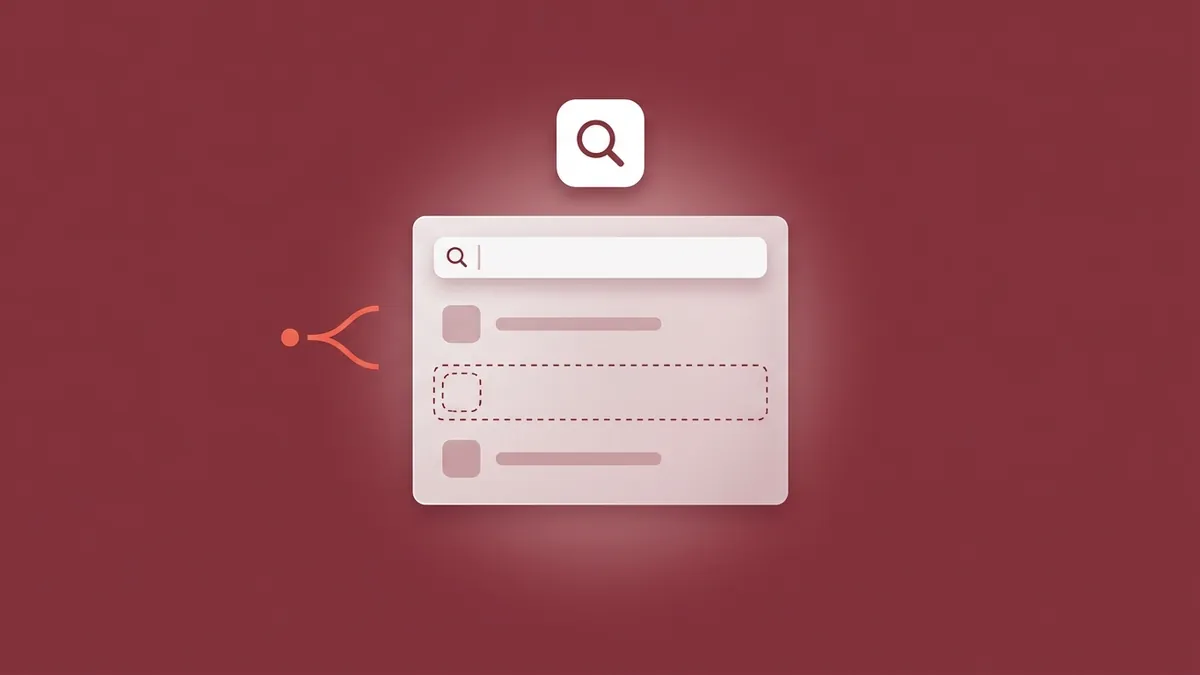
One test tells you. If your app doesn't appear for its exact name in a clean search of a storefront where it's live, it's missing: a visibility fault (Branch A, Checks 1–6). If it appears for its name but lost keyword positions, it's ranking lower: a ranking drop (Branch B, Checks 7–12). Run this fork test before anything else. As of 2026, Apple personalizes Search for signed-in users, so your own iPhone isn't a clean test (Apple, Personalized User Experiences).
The search diagnostic: one fork, 12 checks
The fork test takes five minutes:
- Open the direct link. If your apps.apple.com URL loads the product page, the listing exists.
- Search the exact name twice: in the Keyword Rank Checker for two or three storefronts, then in the App Store app while signed out. Apple says personalization "is not made available" to users who aren't signed in.
- Check your top five keywords in the same storefronts, and note each rank and date.
Why search twice? Our Keyword Rank Checker reads Apple's public iTunes Search API. In thread 815203, one developer reports the API "returns the app correctly," while "the App Store app's own live search does not." So a tool can say present while the store says missing. If the two disagree on your name, you're in Branch A, and the gap is evidence for Check 6.
One exception: a generic name. An app called "Budget" or "Notes" can be indexed yet sit below 200 for its own name. That's a ranking problem, not a missing app, so route it to Branch B.
Is your app live, and has it had time to index?
Most "missing" new apps aren't fully live yet. As of September 2026, Apple's App Store Connect Help says an app in Processing for Distribution "will be ready for distribution within 24 hours" (Apple, App and submission statuses). Availability changes "may require up to 24 hours to be visible to all users" (Apple, Manage availability). That's up to two days before search is even the question.
Check 1: Is the app actually live?
Read the status in App Store Connect. You want Ready for Distribution (older forum posts say Ready for Sale). Pending Developer Release means "accepted, but you still need to release it." Then check agreements: Apple says "to distribute your app, your agreements must be in effect," and the Account Holder accepts new ones in the Business section. A lapsed agreement is an admin fault, not an ASO one.
Pass: Ready for Distribution, agreements active, and the direct link opens the product page.
Check 2: Has enough time passed?
Apple's two documented windows add up to about 48 hours. In forum thread 822348 (April to May 2026), developers put the usual wait at "anywhere from 24 to 72 hours" (Apple Developer Forums, 2026). Our rule: wait 72 hours from Ready for Distribution before escalating. Rank settling is a separate, slower clock; see how long each ASO change takes to settle.
Pass: at least 72 hours since release, in every storefront you're testing.
| Clock | Window | Who says so |
|---|---|---|
| Processing for Distribution | Within 24 hours | Apple |
| Availability change visible to all users | Up to 24 hours | Apple |
| New app appears in search | Commonly 24–72 hours | Developers (forum 822348) |
| Exact name still missing | After 72 hours: run Checks 3–5, then escalate | Our rule |
| Keyword ranks settle | About 4 weeks on iOS | AppTweak |
Can people in that storefront, on that device, see your app?
Not always. An app can be live and still invisible to a particular searcher. As of 2026, Apple lets you pick, one by one, which of 175 countries or regions get your app (Apple, Manage availability). If the searcher's storefront, device or account is excluded, search has nothing to show them.
Check 3: Is it available in the storefront you're searching?
In Pricing and Availability, confirm the country is selected. In the EU, check trader status: Apple said that from February 17, 2025, "apps without trader status will be removed from the App Store in the European Union until trader status is provided and verified" (Apple Developer News, 2025). Finally, confirm the app isn't set up for unlisted distribution. Apple says unlisted apps "don't appear in any App Store categories, recommendations, charts, search results, or other listings" (Apple, Unlisted app distribution).
Pass: storefront selected, trader status verified in the EU, and not unlisted.
Check 4: Can the searching device and account get it?
Hardware is the first gate. Apple's Technical Q&A QA1910 says the App Store "prevents applications which include the arm64 required device capability from being installed on devices that do not support the arm64 instruction set" (Apple, QA1910). Minimum OS versions and iPad-only builds limit devices too. Apple documents the install block, not what search shows on those devices, so never judge visibility from an old test phone.
Age rating is the second gate. Apple added 13+, 16+ and 18+ ratings on July 24, 2025 (Apple Developer News, 2025), and parents can "block apps with specific ratings" (Apple Support). Apple doesn't say whether that hides apps from search or only blocks downloads, so test on an unrestricted adult account.
Pass: the app appears on a compatible, unrestricted device in that storefront.
Did your keywords index, or is Apple's index at fault?
Rule out your own fields before you blame Apple's index. As of 2026, Apple says search results draw on "text relevance (matches for your app's title, subtitle, keywords, and primary category), as well as user behavior (downloads, ratings and reviews, and more)" (Apple Developer, App Store search). If a term isn't in one of those fields, in a localization the storefront indexes, you won't rank for it. If every field is right and your name still returns nothing, the fault may be Apple's.
Check 5: Did your keywords actually make it in?
Look for:
- Spaces after commas in the keyword field, which Apple says to leave out.
- Words already in the name or subtitle, which rarely need repeating.
- Terms only in the description, which isn't on Apple's list of search fields.
- Keywords in a localization that storefront doesn't read. Check which localizations each storefront indexes.
- Trademarks or rival app names. Guideline 2.3.7 rules out "trademarked terms, popular app names," and warns that "Apple may modify inappropriate keywords at any time" (Apple, App Review Guidelines).
Pass: every target term sits in the name, subtitle or keyword field of an indexed localization, with no guideline risk.
Check 6: Is it a genuine index fault, and how do you escalate?
If Checks 1–5 pass and the exact name is still missing after 72 hours, suspect a real index fault. In thread 815203, one app disappeared from App Store search on December 31, 2025 and was still missing on February 10, 2026, with similar reports into September. A developer quotes Apple's reply: "The behavior you observed is expected... we don't guarantee app placement." Removing and re-adding the app had "no effect."
Build an evidence packet before you contact Apple Developer Support:
- App ID, storefronts tested, dates.
- Screen recordings of the exact-name search on a signed-out, compatible device.
- The working direct link and a status screenshot.
- API results, if a rank checker finds the app when the store doesn't.
- Whether Apple Ads can find the app, since Apple says irrelevant apps aren't displayed at any bid (Apple Ads Help).
That last clue is observed, not documented. In thread 822348, one app appeared in Apple Ads but not organic search; in 815203, the campaign flow couldn't find the app at all.
Did you change something, or did the whole store move?
Start Branch B with your own changelog. AppTweak's November 2023 guide warns that "any changes made to the title, subtitle, and the keyword field within the last 4 weeks may still be impacting rankings" (AppTweak, Why Can Your App's Keyword Rankings Suddenly Drop?). If nothing changed on your side and your competitors fell on the same day, suspect a store-wide event.
Check 7: Did you, or the calendar, change anything in the last four weeks?
List every metadata edit, category change, pricing switch and rename from the past four weeks. (The poster in thread 815203 vanished right after switching to freemium.) Renames have their own playbook: renaming without losing rankings. New apps should check the calendar too. AppTweak's October 2025 guide says they "tend to be favored in keyword rankings during the first 7 days" (AppTweak, 2025). In Sensor Tower's historical August 2014 example, one keyword slid from #28 to the #260 range after week one (Sensor Tower, 2014).
Pass: no ranking-relevant change in four weeks, and the app is past its first week.
Check 8: Was it a store-wide event?
Late July 2026 is the case study, and the data is observed, not confirmed. ASO World's chart of U.S. apps losing ranked keywords per day peaks at 94,092 on July 26 (ASO World, July 30, 2026). Yet the same article cites "over 16,000 U.S. apps" on a single day and never reconciles the two. Phiture dates the change to July 27–28, across the US, Canada, Brazil, China and India. Different tools, different dates: read both as direction, not measurement. Apple hasn't confirmed an update.
How unusual was late July 2026?
To test for an event, open AppTweak's free Algorithm Change Detector. It tracks 3,000 branded and 3,000 generic keywords in 150+ countries against 14-day baselines (AppTweak, 2023), and a score "above the +3 threshold" means movement is "unusually high." Then check whether competitors moved the same day.
Pass: no anomaly and competitors stable. Move on to Checks 9–12.
Did Apple or a competitor redefine the query?
Sometimes your listing didn't change, but the query's meaning did. In February 2026, Apple's machine-learning team described ranking on behavioral relevance and textual relevance, "a result's semantic fit to the query." Relevance labels from a fine-tuned LLM produced "a statistically significant +0.24% increase in conversion rate," with the biggest gains on tail queries (Apple Machine Learning Research, 2026).
Check 9: Did Apple reinterpret the query?
The symptom: you lost loosely relevant generic or long-tail terms, while terms matching your core use held. Phiture reads July 2026 the same way, cautiously: "One possible observation is that the algorithm is placing greater emphasis on semantic relevance, although this has not yet been confirmed or validated at scale." At WWDC in June 2025, Apple also said its LLMs would generate App Store Tags from app metadata, which developers can deselect (TechCrunch, June 2025). The fix is fewer, higher-intent terms: rebuild your keyword set around intent.
Pass: the lost terms are ones your app genuinely serves.
Check 10: Did a competitor move?
New entrants, competitor metadata or category changes, and featuring can all reshuffle a results page, per AppTweak's list of sudden-drop causes. Pull the top 10 for each lost keyword in the Keyword Rank Checker and compare it with your last snapshot. Who's new? Who renamed? Who added your term? For why a newcomer can leapfrog you, see the two engines Apple ranks on.
Pass: the top 10 matches your last snapshot.
Did your conversion slip, or did the page change around you?
Either one can cost you search installs without a single metadata change. As of 2026, Apple says ratings and reviews "can influence how your app ranks in App Store search" (Apple Developer, App Store search). The same page lists user behavior beside text relevance as a ranking input, so a conversion or ratings slide can drag ranks down on its own. And since March 2026, the results page itself carries more ads.
Check 11: Did conversion or ratings slip?
In App Store Connect, compare conversion for the App Store search source, and your rating trend, before and after the drop date. Look for a buggy release, a burst of one-star reviews, or a screenshot or price change. If the rating is the culprit, here's how to recover a slipping rating.
Pass: search conversion and rating trend are flat.
Check 12: Did the page change, not your rank?
Apple Ads began filling a second search-results slot on March 3, 2026, reaching all markets by the end of March on iOS and iPadOS 26.2+ (MacRumors, January 2026, citing Apple). Advertisers "can't select or bid for a particular ad position" (Apple Ads Help), and Adapty places the new ad at position 3, "right inside the organic results stack" (Adapty, 2026).
The trap: App Store Connect's App Store search source "includes views and downloads from ads that appear in App Store search results" (Apple, App Store Connect Analytics Help). Net out paid installs with your Apple Ads reports first. Brand terms matter most; AppTweak's 2024 data had branded keywords driving 49% of App Store traffic from 24% of keywords (AppTweak, 2024). See what the second ad slot does to brand searches.
Pass: organic rank and organic search installs hold steady once ads are netted out.
Your rank may not have moved. The page did. A tracker reads organic positions, so it reports the same rank after an ad slides in above you. Apple Ads says "nearly 65 percent of downloads happen directly after a search" (Apple Ads, 2022 data), and an extra ad in the organic stack takes a share of that moment.
What should you do in the first 72 hours?
Record, route, wait on the right clock, then act, and don't touch metadata until you know your branch. Phiture's August 2026 advice after the July volatility: "We do not recommend releasing new metadata updates immediately, as this could create further volatility or negatively affect performance" (Phiture, ASO Monthly #121).
There's a measurement reason too: a fix shipped mid-event can't be read, because its four-week settling clock overlaps the event.
- Hour 0: snapshot lost keywords (rank, storefront, date) and export App Store Connect search impressions and conversion.
- Day 1: run the fork test, then Checks 1–5 (Branch A) or 7–8 (Branch B).
- Day 3: Branch A still missing? Send the Check 6 packet. Store-wide event? Hold, and re-read at two and four weeks. A specific cause? Fix it in one release.
| Symptom | Start at | First action | Re-check |
|---|---|---|---|
| Missing everywhere, even by name; new app | Checks 1–2 | Confirm status and agreements; wait | 72 hours |
| Missing in one country only | Check 3 | Availability, trader status, unlisted | 24 hours |
| Missing on one device only | Check 4 | Test a compatible, unrestricted device | Same day |
| Found by name, not by generic terms | Checks 5, 9 | Keyword fields and localization | Next release, then ~4 weeks |
| Many keywords lost overnight, competitors too | Check 8 | Hold metadata | 2 and 4 weeks |
| A few terms lost, one competitor up | Check 10 | Compare the top 10 | Weekly |
| Rank flat, search installs down | Checks 11–12 | Net out Apple Ads; check conversion | 1–2 weeks |
What not to do
- Trust your own phone. It's personalized, may be restricted, and may be in the wrong storefront.
- Remove the app to "force re-indexing." Forum reports show no fix, and Apple says removal applies everywhere within 24 hours.
- Panic-ship metadata into a store-wide event.
- Read "App Store search" downloads as organic. They include ads.
Once the fire is out, run the full 60-check ASO audit to find what else is capping your visibility.
Frequently asked questions
How long does it take for a new app to appear in App Store search?
As of 2026, Apple says Processing for Distribution finishes within 24 hours, and availability changes can take up to 24 hours to reach all users. Developers commonly report 24 to 72 hours before search picks up a new app. If the exact name is still missing after 72 hours, run the storefront, device and keyword checks, then contact Apple.
Why can't I find my app when I search its exact name?
Usually one of four reasons: it isn't live in that storefront (EU trader status included), your device or account can't get it, it's set up as unlisted, or the name is a generic word that ranks deep. If none apply after 72 hours, suspect a genuine index fault. Forum cases show those can last weeks, so escalate with evidence.
Why did my App Store keyword rankings drop overnight?
Check your own changes from the last four weeks first, as AppTweak advises, then whether competitors fell the same day. A shared drop points to store-wide volatility like late July 2026. A drop only you saw points to your metadata, conversion, ratings, a competitor move, or an ad now sitting above you.
Was there an App Store algorithm update in July 2026?
Third-party monitoring says something changed; Apple hasn't confirmed it. ASO World's chart of U.S. apps losing keywords peaks at 94,092 on July 26. Phiture reported changes on July 27 and 28 in the US, Canada, Brazil, China and India, with India's anomaly score at 22.8 against a typical score below 2. A semantic-relevance shift is suspected, not confirmed.
How do I check my App Store ranking for a keyword?
Use a rank checker that runs the search for a chosen country without your personal history, because Apple personalizes Search for signed-in users. Our free Keyword Rank Checker shows the live top 200 in 50 storefronts with no sign-up. If your app looks missing, confirm in the App Store app while signed out.
Does the same thing happen on Google Play?
The fork works the same way, but the clocks differ. Google's Play Console Help says processing can take a few hours or up to seven days. Stability also costs reach: above a 1.09% user-perceived crash rate or a 0.47% ANR rate, Android Developers says Play may reduce the visibility of your title.
The bottom line
Diagnose before you fix:
- Fork first: missing for your name is a visibility fault; findable but lower is a ranking drop.
- Use Apple's clocks: about 24 plus 24 hours, so escalate after 72 hours, not a week.
- Rule out admin causes: storefront, trader status, device and age rating.
- Hold during volatility: re-read at two and four weeks.
- Net out ads before calling an organic drop.
Check where you rank today in the free Keyword Rank Checker. If the answer isn't obvious, our fixed-price ASO audit runs this diagnosis on your app and turns it into a prioritized fix list. Book a free 30-minute call to start.