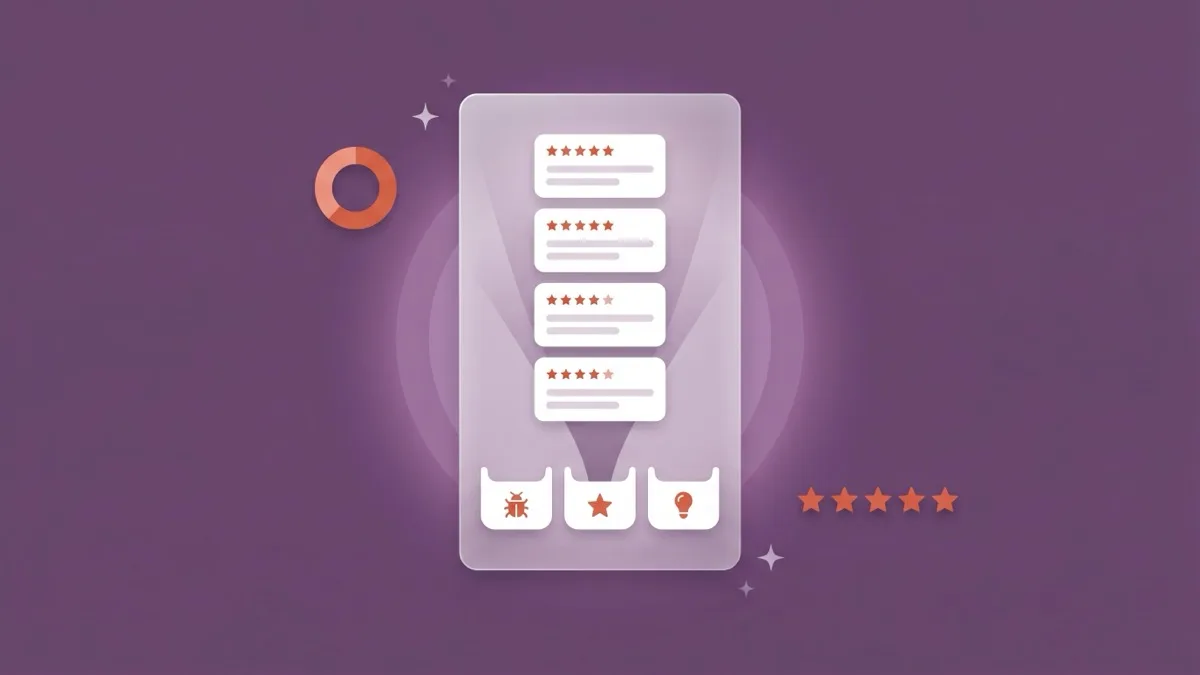
Rating prompts timed to the right moment, reply playbooks for every kind of review, and sentiment tracking that catches problems before they reach your average. Your rating sits beside your first screenshot, so it lifts or drags everything else on the page.
Included in Growth and Full-Stack · Month-to-month · No long-term contracts
Ratings do two jobs at once. They're a quality signal in ranking, and they're the number people see before they tap. Apps holding a 4.5+ average over the last 90 days install at 1.7 times the rate of apps under 4.0 (Digital Applied, 2026), and below roughly 3.5 stars, keyword visibility drops sharply (AppFollow, 2026). We manage your rating like any other metric: what moves it, what's dragging it, and what users are telling you in the same words they search with.
What you get
A rating prompt plan: where and when to ask, within Apple's limit of three prompts per user per year.
Reply playbooks for bugs, pricing complaints, feature requests and praise, with priorities.
Sentiment tracking by theme, so you see problems before the star average moves.
Review summary monitoring in the storefronts where Apple shows AI-written summaries.
Review language mined for keywords and screenshot captions.
Recovery plans after a bad release, without the shortcuts that get apps removed.
What's included
Earning ratings, answering reviews, and reading what they say.
Rating prompt strategy
The native prompt (StoreKit on iOS, the In-App Review API on Android), fired at moments of satisfaction like a completed task, never on launch. iOS shows it at most three times per user per year, so timing beats frequency.
Reply playbooks
When you reply on the App Store, Apple notifies the reviewer, who can update their review. On Google Play, a reply to a negative review lifts that rating by 0.7 stars on average (Google Play Console, 2026).
Sentiment tracking
Every review tagged into a fixed five-part taxonomy (bug, UX, feature, pricing, praise) and tracked by theme over time, prioritized by frequency, severity and trend.
Review summaries
Apple's AI-written summaries show in the US and eight other English-language storefronts. You can't edit them, so we track changes and shift them by fixing the top complaint.
Keyword mining
Praise in 4–5 star reviews is the vocabulary people search with; complaints are positioning angles. Try it on any app with our free app review keyword analyzer.
Recovery plans
After a bad release, the fix is the bug, then replies, then prompts to happy users, because Apple weights recent reviews. We never buy reviews: it risks removal.
The thresholds that matter
Your average isn't a vanity number. A few lines on the star scale change how both stores treat your app and how people react to it.
80% of people distrust apps under four stars (Business of Apps, 2026), and tap-through falls with them.
4.5 stars and above
Apps holding 4.5+ over the last 90 days install at 1.7 times the rate of apps under 4.0 (Digital Applied, 2026).
Google Play goes further: it indexes the text of your reviews as a relevance signal, and ratings and review sentiment are estimated at 25–30% of its ranking weight (MobileAction, 2026).
Sentiment moves before the average
A star average is slow. It can sit at 4.3 for months while the language underneath turns negative about one feature. That's why we track themes rather than single reviews: count how often a problem appears, see whether it's growing, and check that it falls after a fix. In one case AppTweak tracked, mentions of "account" in one-star reviews fell 39% after the fix shipped. The method is in our guide to analyzing App Store reviews.
What we won't do
We don't buy reviews or offer rewards for ratings. Those shortcuts break store rules and put the whole listing at risk. The durable route is slower but safe: fix what people complain about, reply to them, and ask satisfied users at the right moment.
How an engagement runs
The first two weeks map your rating, your review themes and your prompt. After that, reviews are monitored continuously and reported monthly.
01 · Week 1
Review audit
Rating level and trend, top themes in low reviews, reply coverage, and where your rating prompt currently fires.
02 · Week 2
Prompt & reply plan
Where to move the prompt, reply playbooks by review type, and the complaint to fix first.
03 · Ongoing
Monitor
Sentiment tracked by theme, spikes flagged early, and playbooks updated as new issues appear.
04 · Monthly
Report & mine
Rating, sentiment and theme trends, review summary changes, and the review language worth adding to your metadata.
Pricing
Ratings and reviews management is part of our Growth plan, alongside keyword optimization and conversion testing, because all three move the same product page. Month-to-month, cancel anytime.
Yes. Below roughly 3.5 stars keyword visibility drops sharply, and above 4.0 rankings improve. Apple doesn't index review text for search, but your rating and review velocity feed its quality signals and your conversion rate. Google Play also indexes review text as a relevance signal.
How do we get more App Store ratings?
Use the native in-app prompt (StoreKit's requestReview on iOS, the In-App Review API on Android) and trigger it after a moment of satisfaction, such as a completed task or milestone, never on app open. iOS shows the prompt at most three times per user in 365 days, so timing matters more than frequency.
Should we reply to negative reviews?
Yes, quickly and specifically. Acknowledge the issue and name the fix or the version that contains it. Apple notifies the reviewer when you respond so they can update their review, and on Google Play a reply lifts a negative review's rating by 0.7 stars on average.
Can we change our App Store review summary?
Not directly. Apple generates it from your reviews and there's no setting to edit or hide it. You can report factual errors in App Store Connect. To shift future summaries, fix the dominant complaint, reply to the people who raised it, and prompt satisfied users after the fix.
Should we reset our App Store rating?
Rarely. Apple's reset option is permanent, applies to all regions and leaves written reviews visible. Because Apple weights recent reviews, fixing the cause and prompting satisfied users after the fix is usually the better route.
How much does ratings and review management cost?
Ratings and reviews management is included in our Growth plan at $3,990 per month, together with keyword optimization and conversion testing for one app on both stores. It's also part of Full-Stack. Both are month-to-month.
Ratings & reviews guides
How reviews affect ranking, how to analyze them at scale, and how to mine them for keywords.