Most teams treat App Store Optimization as a launch-day chore: write a title, stuff the keyword field, ship a few screenshots, and move on. Then growth flattens and nobody can explain why. The reason is almost always the same — ASO was run as a checklist instead of a system.
An effective ASO strategy is a loop that connects six moving parts: goals, keywords, competitors, creatives, ratings, and iteration. Get the parts working together and each one feeds the next. The stakes are high because this is where discovery happens — search drives roughly 65% of all App Store app discovery in 2026, far more than browse, referral, or ads (Digital Applied, 2026). This is the framework, step by step, in the order to actually run it.
Key Takeaways
- An ASO strategy is a flywheel, not a checklist: rankings → impressions → conversion → installs → ratings & retention → better rankings. Tactics done in isolation leak the wheel.
- Run six steps in sequence: set goals & KPIs, audit keywords, study competitors, optimize metadata & creatives, build ratings & localization, then iterate.
- The leverage is real — search is ~65% of iOS discovery, and your first three screenshots drive ~80% of the install decision (Searchlab, 2026).
- Iteration cadence is the real differentiator: separate keyword and creative changes, allow 3–4 weeks between major updates, and expect movement in 4–8 weeks but compounding growth over 3–6 months.
What is an ASO strategy, and why does "set and forget" fail?
An ASO strategy is a structured, ongoing plan to grow an app's store visibility and conversion through coordinated keyword, metadata, creative, ratings, and iteration work — measured against defined KPIs. The key word is ongoing. A single round of optimization is an event; a strategy is a loop you keep turning.
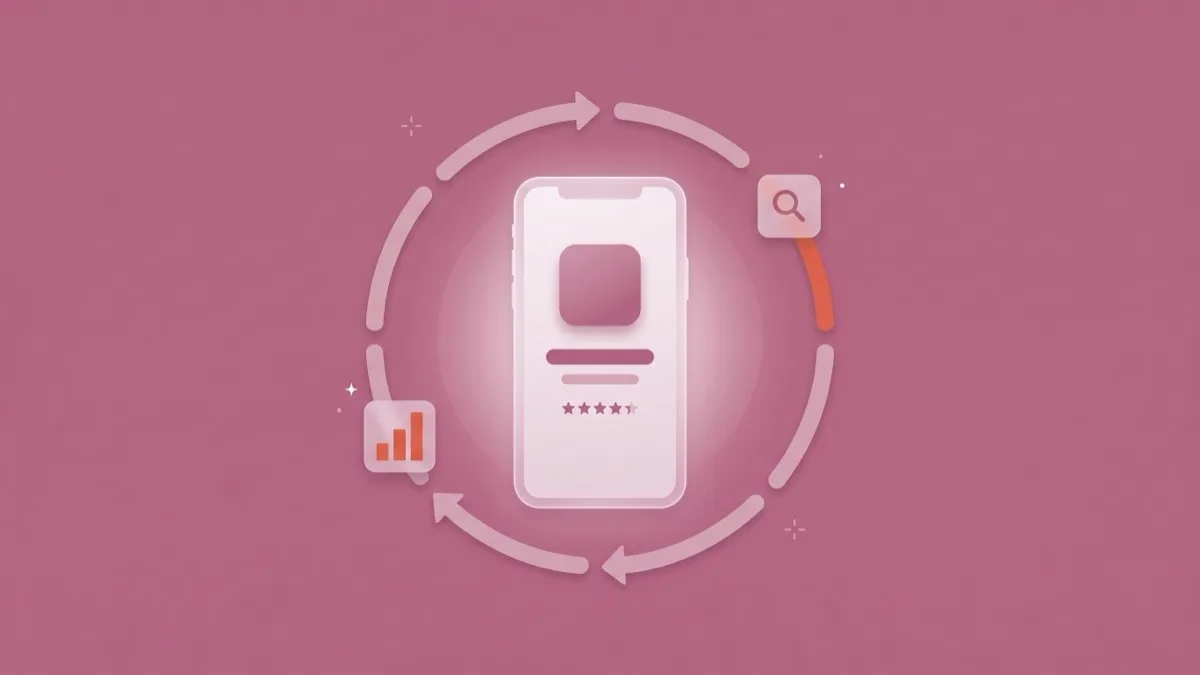
The useful way to picture it is a flywheel. Better keywords and metadata lift your rankings; higher rankings earn more impressions; stronger creatives convert those impressions into installs; installs and good experiences generate ratings and retention; and those behavioral signals lift your rankings again. Every step feeds the next turn of the wheel. Pull one lever in isolation — a perfect title with weak screenshots, or great screenshots no one ever sees because the keywords are wrong — and the wheel slips. That is why "set and forget" fails: it optimizes one spoke and starves the rest.
It also explains why search deserves most of your attention. Because roughly 65% of App Store discovery starts with a search (Digital Applied, 2026), the visibility half of the wheel lives or dies in the search results — and the conversion half decides what you do with the traffic you earn there. A complete strategy works both halves at once. For a deeper look at what the algorithm rewards on the visibility side, see our breakdown of every App Store ranking factor that matters.
Share of App Store app discovery that starts in search
Step 1: How do you set ASO goals and KPIs?
Start by defining one primary growth objective and the KPIs that prove it — before you touch a single field. A good objective is specific and tied to the business: "grow organic installs in our top three revenue markets," not "rank higher." (This all assumes the market itself is validated — if you're pre-launch, start with app market research first.) Then choose the metrics that show whether you're getting there.
Split your KPIs into two layers. Diagnostic KPIs tell you where the wheel is slipping: keyword rankings and impressions for visibility, tap-through and conversion rate for the listing. Outcome KPIs tell you whether it's working: organic installs and, downstream, retention and revenue. The reason conversion sits near the top of the list is leverage — it applies to all of your existing traffic at once, so even a 3–5% conversion improvement can materially increase organic installs without a single extra impression (AppTweak, 2026).
Whatever you pick, baseline it before you change anything. You cannot prove an ASO win if you never recorded where you started — and "we think it went up" is not a result you can build a strategy on.
Step 2: How do you audit keywords and search intent?
Audit your current rankings first, then build keyword sets around search intent and themes, not isolated high-volume terms. Modern App Store and Google Play search reward relevance to what a user is actually trying to do, so the winning move in 2026 is to build topical authority around a theme rather than chasing one trophy keyword (AppTweak, 2026).
Score every candidate keyword on three axes: search volume (is anyone looking?), difficulty (can you realistically rank?), and relevance (does it match your app and convert?). The sweet spot is high-relevance, mid-difficulty terms where you can actually win — not the highest-volume head term where you'll never crack the top ten. Mine your competitors' metadata and your own reviews for the language real users use; they rarely describe your app the way your product team does.
Then place those terms correctly. Apple gives you a 30-character title, a 30-character subtitle, and a hidden 100-character keyword field, and it de-duplicates across them — so a word spent twice is a keyword you didn't claim. Our guide to spending your 30-character title on keywords versus brand walks through the highest-leverage call in your metadata. To do the mechanical work cleanly, our free Keyword Field Optimizer packs the 100-character field without waste, and the Keyword Density Checker flags terms you've accidentally repeated.
Step 3: How do you analyze competitors?
Benchmark the apps already ranking for your target keywords — their metadata, creative angles, ratings, and update cadence reveal both the gaps you can exploit and the bar you have to clear. Competitive analysis isn't copying; it's calibration. With over 2 million apps on each store, you're competing for the same finite set of queries, so you need to know who already owns them and why (Digital Applied, 2026).
Run two passes. First, a keyword-gap pass: which terms do your competitors rank for that you don't, and which of those are realistic to contest? Second, a creative teardown: what do their first three screenshots promise, what benefit leads, and where is their messaging generic enough to beat? Separate your direct rivals from the broader category leaders — the leaders show you the ceiling, the rivals show you the fight you can win this quarter. Picking the right tooling for this is its own decision; our roundup of the best ASO tools in 2026 covers what to use for keyword and competitor data.
Step 4: How do you optimize metadata and creatives?
Pair high-intent keyword placement with first-impression creatives, because metadata earns the visit and creatives close it. On iOS, the first three screenshots carry most of the weight. They render above the fold and drive roughly 80% of the install decision, which makes them the single highest-leverage surface you control (AppTweak, 2026). Strong screenshots alone can add a 20–40% conversion boost over weak ones (Digital Applied, 2026).
Treat metadata and creative as one workstream. Your title, subtitle, and keyword field set which searches you appear for; your icon, screenshot captions, and preview video decide whether the people who see you tap install. The captions on those first frames now do double duty — they have to read cleanly to a human and carry keyword weight at the same time. Before you ship, preview the listing exactly as users will see it with our free Store Page Preview, and check every field against the limits with the Metadata Character Counter.
One under-used lever sits here too: Custom Product Pages, which let you match a tailored listing to a specific audience or ad. Only about 31% of apps and 26% of games use them, yet those that do see conversion lifts of up to 8.6% — and SoundCloud used them to raise its Apple Ads conversion rate by 58% while cutting cost-per-install 39% (DualMedia, 2026). If conversion is the spoke holding your wheel back, our guide to increasing your app conversion rate sequences every lever, and our team folds keyword intent into screenshot and creative testing rather than treating them separately.
Step 5: How do ratings, reviews, and localization fit the strategy?
Ratings gate conversion and localization multiplies reach — together they decide how far the rest of your work travels. Star rating is a store-wide quality signal: drop below 4.0 and tap-through falls sharply, while a steady stream of recent, positive reviews reads as a freshness signal that supports both ranking and conversion. Protecting that score is foundational, which is why we treat ratings and reviews management as a core workstream; the full playbook lives in our complete guide to App Store reviews.
Localization is one of the biggest levers most teams skip, though its most-quoted number needs context. The "+128% downloads" figure comes from Distimo's September 2012 report on around 200 iPhone apps that added the native language: downloads rose over 128% in the week after versus the week before, revenue about 26%, and iPad apps saw no significant download growth. Distimo itself said crediting the language alone "is hard to tell" (Distimo, 2012). The stronger signal today is what top apps do: 88% of top App Store apps localize their subtitles and 82% localize their descriptions (AppTweak, 2026). The catch: real localization means translating the screenshots and the keyword pool for each market, not just running the text through a translator. Before you translate anything, prioritize your localization markets. Our guide to localizing app screenshots for new markets covers how, and localization across your priority markets is built to map keyword pools and creative market by market.
Change one week after ~200 apps added the native language (2012)
Step 6: How do you iterate and measure (the cadence)?
Run ASO as a fixed loop — research, hypothesis, test, analyze, roll out — and let the cadence, not any single edit, be the thing that compounds. The discipline that separates growing apps from stalled ones is boring: change keywords and creatives in separate releases, and leave 3–4 weeks between major updates so each result is readable (see a week-by-week ASO timeline). Change both at once and you'll never know which move worked.
Test your creatives properly. A/B testing store listings delivers an average 17–26% conversion uplift, which is why 57% of top games test their screenshots and icons multiple times a year (SplitMetrics, 2026). Set expectations on timeline, too: most apps see measurable movement within 4–8 weeks, but the real, compounding growth shows up over 3–6 months of continuous optimization (AppTweak, 2026). The teams that quit at week six because "it didn't work" are quitting right before the curve bends.
In our own client work, the strongest predictor of whether ASO compounds isn't budget or category. It's whether one person actually owns the loop. The apps that assign that ownership and hold the cadence are the ones still climbing at month six; the ones that treat each update as a one-off tend to stall right where the curve below starts to bend. The framework isn't the hard part. Running it on schedule, release after release, is.
Typical ASO results curve over time
Hold one mental model and the whole strategy gets simpler: ASO is a flywheel, not a checklist. Rankings earn impressions, impressions convert to installs, installs build ratings and retention, and those signals lift rankings again. Every step in this framework is a spoke that feeds the next turn of the wheel — which is exactly why isolated tactics underperform. When an ASO effort stalls, it's almost always because someone polished one spoke and ignored the rest, so the wheel never gets enough momentum to spin on its own.
Does the strategy differ for App Store vs. Google Play?
The framework is identical; the levers differ. The same six steps — goals, keywords, competitors, creatives, ratings, iteration — apply to both stores. What changes is the machinery underneath, so one strategy still needs two execution builds.
| Lever | App Store (Apple) | Google Play |
|---|---|---|
| Keyword input | Discrete 100-character keyword field; description not indexed for ranking | Title plus short and long description indexed as ranking text |
| Creative testing | Product Page Optimization (on-device, up to 3 treatments) | Store Listing Experiments (native A/B in Play Console) |
| Tailored pages | Custom Product Pages, assignable to ads and keywords | Custom store listings by audience and country |
| Update rollout | Manual app review; slower to go live | Largely automated; faster rollout |
Run one strategy, but localize the execution per platform rather than copy-pasting metadata between them. Apple rewards a tight, comma-separated 100-character field, while Google Play reads your whole listing as ranking text (Apple Developer, 2026). Our breakdown of the ASO differences that matter between the App Store and Google Play covers each divergence, and Google Play's ranking factors map the Android side of the same loop. And if you're weighing a third surface, our take on whether to invest in the visionOS App Store covers where spatial fits a 2026 strategy.
What are the most common ASO mistakes?
The most common ASO mistakes are treating it as a one-time task, testing two things at once, chasing keywords you can't rank for, skipping localization, and buying installs before fixing conversion. Each one breaks the flywheel at a different spoke. Run a quick self-audit against the five that stall the most apps (or use a scored ASO audit checklist with pass/fail thresholds for the full version):
- Set-and-forget. Optimizing once and moving on. ASO only compounds with a repeating cadence, and movement takes 4–8 weeks with real growth at 3–6 months (AppTweak, 2026).
- Testing two things at once. Shipping new keywords and new screenshots in the same release makes every result unreadable. Change one variable per cycle.
- Chasing trophy keywords. Targeting the highest-volume head term instead of the high-relevance, mid-difficulty keywords you can realistically win.
- Skipping localization. Leaving non-English markets on an English-only listing, or "localizing" the text without translating the screenshots.
- Buying installs before fixing conversion. Paid traffic amplifies a leaky listing. Fix the rating and the first three screenshots before you scale acquisition.
What advanced ASO tactics are worth adding?
Once the six-step loop runs cleanly, the highest-ROI advanced moves are Custom Product Pages, continuous creative A/B testing, and pairing paid search with organic. None of these replace the fundamentals; they compound them. The same goes for GEO for apps, which builds on the listing you already optimize.
Custom Product Pages are the most under-used: only about 31% of apps run them, yet they lift conversion by up to 8.6% by matching the listing to a specific audience or ad (DualMedia, 2026). Layer in continuous A/B testing, where top games test creatives several times a year for a 17–26% average uplift (SplitMetrics, 2026), and use Apple Search Ads or Google App Campaigns to feed the velocity and conversion signals your organic rankings already read from. Done together, paid warms up the very keywords your organic strategy is climbing. For the tooling that makes this manageable at scale, see our roundup of the best ASO tools in 2026.
Frequently asked questions
How long does an ASO strategy take to work?
Most apps see measurable movement within 4–8 weeks of consistent work, but compounding growth arrives over 3–6 months of continuous optimization (AppTweak, 2026). ASO is a loop, not a launch-day task — the apps that win keep iterating after the first update.
What KPIs should I track for ASO?
Track keyword rankings and impressions for visibility, tap-through and conversion rate for the listing, and organic installs as the outcome. Conversion is the highest-leverage metric because it applies to all existing traffic — a 3–5% lift can materially grow installs (AppTweak, 2026).
How often should I update my store listing?
Run a fixed cadence of roughly every 3–4 weeks, and separate keyword changes from creative changes so you can read each result cleanly. Changing metadata and screenshots in the same release makes it impossible to know which move drove the result.
Is localization worth it for ASO?
Yes, especially in markets where you already see traffic. Just read its most-quoted number with care: the +128% download lift comes from a one-week 2012 Distimo study of about 200 iPhone apps that added the native language. iPad apps saw no significant download growth, and Distimo said it was hard to tell whether the language alone caused the lift (Distimo, 2012). Treat it as direction, and localize the screenshots, not just the text.
Do I need paid ads for an ASO strategy to work?
No. Search drives ~65% of App Store discovery, so a strong organic strategy stands on its own (Digital Applied, 2026). Paid and organic compound, though — Custom Product Pages that match ad intent can lift conversion up to 8.6% (DualMedia, 2026).
The bottom line
An effective ASO strategy isn't a longer checklist — it's a flywheel you keep turning. The six steps build on each other: goals tell you what to measure, keyword and competitor work decide what you appear for, metadata and creatives decide whether you convert, ratings and localization decide how far that reach travels, and iteration is the engine that compounds all of it. The practical order of operations:
- Set one clear objective and baseline your KPIs before changing anything — conversion is your highest-leverage metric.
- Build keyword and creative work together, around intent rather than single trophy terms, and localize the execution per platform.
- Then iterate on a fixed 3–4 week cadence — separate variables, give each test room, and expect the curve to bend at months 3–6.
If you'd rather have someone map this loop with you and tell you which spoke is holding your app back, that's exactly what a free ASO audit is built to find.