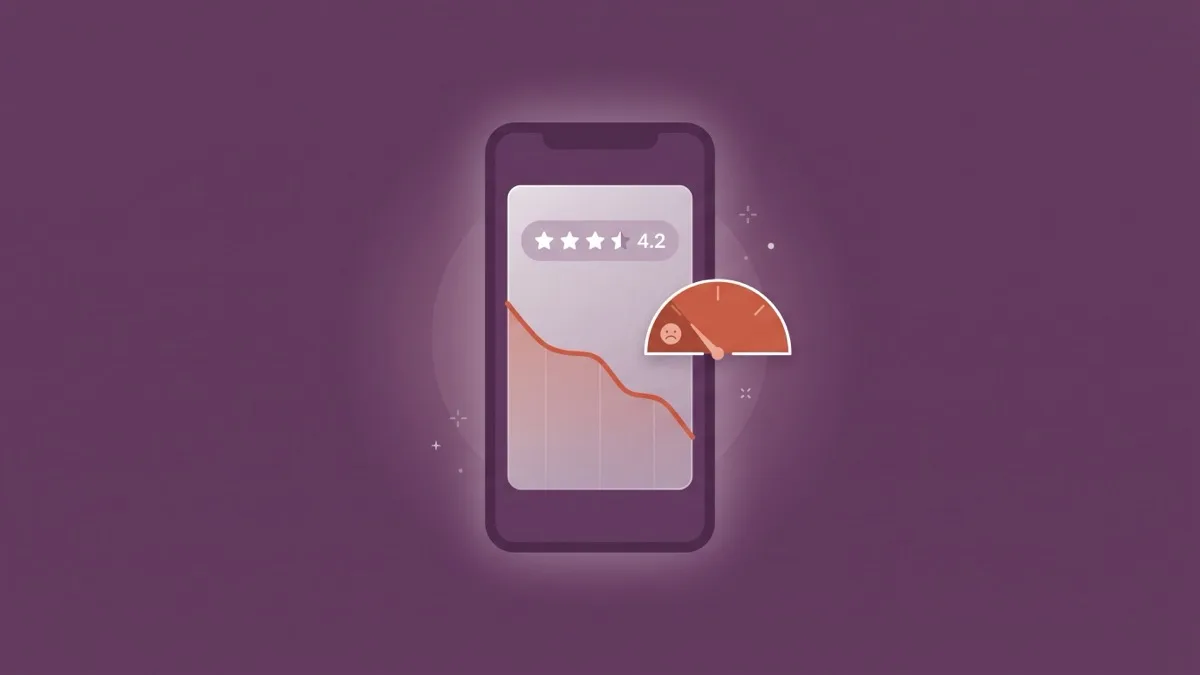
Around 79% of users check an app's ratings and reviews before they download it — but the star number they see is an average of averages that can sit frozen at 4.2 while how people actually feel is quietly falling apart underneath it (AppFollow, 2026). Most teams "measure" sentiment by glancing at that star count, so a rising tide of frustration on one feature, or in one country, stays invisible until the average finally moves — months too late to fix cheaply.
Measuring customer sentiment means turning that pile of review text into a number you can track: a score, a trend, and a set of segments. This guide covers the core net sentiment formula, the seven metrics worth watching, what "good" actually looks like in 2026, how far you can trust automated analysis, and how often to measure. It's the measurement layer that sits inside the broader review-analysis workflow — zoomed all the way into the question of how you score how users feel.
Key Takeaways
- Start with the net sentiment score: percentage of positive reviews minus percentage of negative, over a fixed window (AppFollow, 2026).
- One score isn't enough — track seven metrics, with incremental rating and theme sentiment the two most teams ignore.
- Use 2026 benchmark bands: 80%+ positive with under 10% negative is excellent; 50–64% positive is mixed (AppFollow, 2026).
- Automated tools hit 80–90% accuracy on clear reviews and 85%+ for GPT-4-class aspect analysis, but miss sarcasm — so sample-audit (arXiv, 2025).
- Measure daily for triage, act weekly on the trend — daily decisions just chase noise.
What does measuring sentiment actually mean?
Measuring customer sentiment is the process of converting unstructured review text into a structured score — classifying each review as positive, negative, or neutral, then rolling those into a single metric and a trend. It differs from your average star rating in three ways: it reads the words rather than the stars (a four-star review can be net-negative), it can be segmented by theme or region, and it's a leading indicator rather than a slow-moving lifetime average.
That last difference is the whole point. The star average is a lagging, averaged vanity metric; sentiment — especially incremental and per-theme sentiment — is a leading, segmented diagnostic. Two apps can both show 4.3 stars and be heading in opposite directions. Measuring sentiment is how you see the trajectory before the star average, and the ranking it props up, starts to move. It sits squarely on the behavioral engine behind your rankings described in the 2026 App Store ranking factors breakdown — the early-warning gauge that keyword work can't substitute for. This is the measurement step; for getting more reviews and replying to them, see our complete guide to App Store reviews.
How do you calculate a net sentiment score?
The fastest, most reportable metric is the net sentiment score: the percentage of positive reviews minus the percentage of negative reviews over a fixed window (AppFollow, 2026). For a normalized scale, use (positive − negative) ÷ all reviews × 100, which produces a value from −100 to +100 (Thematic, 2026). Take a clean example: of 100 reviews in a week, 70 are positive, 15 neutral, and 15 negative. Net sentiment is 70 − 15 = +55.
Two rules make the number trustworthy. First, define positive and negative once — commonly 4–5 stars positive and 1–2 stars negative, or a consistent text classifier — and never change it mid-trend, or the line becomes meaningless. Second, fix your window (a rolling 7- or 30-day period works) and compare like with like. The reason to bother: in client review audits we've watched an app's average star rating hold flat near 4.2 across a quarter while its net sentiment slid double digits, because fresh four-star reviews were carrying negative language about a single feature. The stars said "fine." The sentiment said "act now."
Net sentiment from one 100-review week: positive % minus negative %
Which 7 metrics should you actually track?
One score isn't enough, because a single number can't separate how loud feedback is from how positive it is, or tell you where it's coming from. AppFollow recommends tracking seven complementary metrics for app reviews: net sentiment score, incremental rating, theme sentiment, regional sentiment, review volume, average rating, and reply rate (AppFollow, 2026). Together they turn a flat score into a diagnostic you can route.
The two most teams skip are incremental rating — which looks only at recent reviews, so a healthy lifetime average can't hide a current slide — and theme sentiment, covered in the next section. Review volume and average rating give you scale and the headline number; regional sentiment catches a problem isolated to one market or language; and reply rate ties into responsiveness, which our App Store reviews guide covers as a ranking and recovery lever.
| Metric | What it measures | What it answers |
|---|---|---|
| Net sentiment score | Positive % minus negative % over a window | Is the balance of feeling positive or negative right now? |
| Incremental rating | Average rating of recent reviews only | Is the latest release helping or hurting? |
| Theme sentiment | Sentiment + rating per tagged feature | Which feature is dragging the score? |
| Regional sentiment | Sentiment split by country or language | Is one market quietly breaking? |
| Review volume | Count of reviews received | Did something spike feedback up or down? |
| Average rating | Lifetime or windowed star average | What's the headline number users see? |
| Reply rate | Share of reviews the team responds to | Are we closing the loop with users? |
How do you measure sentiment per feature?
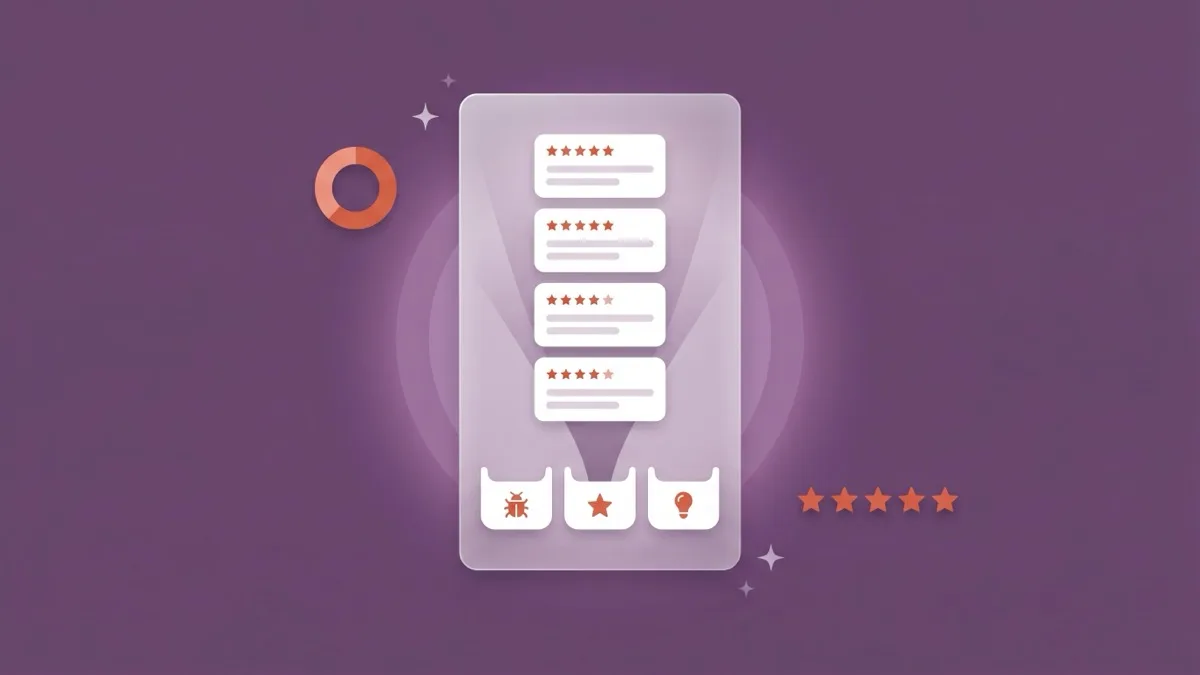
Aspect-based sentiment — also called theme sentiment — scores each topic inside a review separately, because one review can be positive about pricing and negative about performance at the same time (Nextiva, 2026). Tag reviews into a fixed set of themes — crash, login, subscription, ads, onboarding, performance — then compute a net sentiment and average rating per theme, tracked over time. This is where sentiment stops being a vanity number and becomes a roadmap input. (Use the same fixed taxonomy from the review-analysis workflow rather than inventing buckets here.)
Document-level sentiment averages a review into one verdict; aspect-based sentiment keeps the verdicts separate, which is what lets one bad theme explain an otherwise healthy app. A worked example from a client: overall sentiment looked comfortably "healthy" at 71% positive, but when we split by theme, the onboarding theme was sitting at just 38% positive. The team reworked the first-run flow, and onboarding theme sentiment climbed to 64% the next cycle while incremental rating rose 0.4 stars — a move the blended score had been hiding entirely.
The average star rating is a lagging, averaged vanity metric. Sentiment — especially incremental and per-theme — is a leading, segmented diagnostic. A 4.3-star app climbing and a 4.3-star app sinking look identical on the listing, so the star number can't be your early-warning system. Measuring sentiment is how you read the trajectory before the rating moves, which is why it's the gauge that sits on the behavioral engine, not a support afterthought.
What's a good sentiment score? The 2026 benchmark bands
Use benchmark bands, not a single magic number. A practical 2026 reference set: 80%+ positive with under 10% negative is "excellent," 65–79% positive (10–20% negative) is "healthy," 50–64% positive (20–30% negative) is "mixed," and 35–49% positive with 30–45% negative signals a "structural problem" (AppFollow, 2026). The bands give you a quick read on where an app sits, but they're a guide, not a verdict.
Two adjustments make them useful. First, benchmark against your own prior periods and your category — a 60% "mixed" score might be category-leading in a notoriously cranky vertical and poor in a delight-driven one. Second, pair the band with direction of travel: a "mixed" app trending up beats a "healthy" app trending down, because the trend tells you where the next rating move is heading. The sample week from earlier — 70% positive, net +55 — lands in "healthy," with room to push toward excellent by closing whichever theme is dragging it.
2026 sentiment benchmark bands (by share of positive reviews)
How accurate is automated sentiment analysis?
For clear, non-sarcastic reviews, automated sentiment tools reach roughly 80–90% accuracy on positive/negative classification and high-level topics (AppFollow, 2026). Modern large language models push higher on the hard part — aspect extraction — where a prompt-driven GPT-4 model beat a fine-tuned DeBERTa-v3-large by 5.1% on F1, with GPT-4-class models clearing 85% accuracy on app-review aspects (arXiv, 2025). Purpose-built machine-learning models do well too: an LSTM classifier reached about 92% accuracy on mobile app reviews in one evaluation (arXiv, 2024).
The catch is consistent across every method: accuracy drops on sarcasm, mixed emotions packed into one review, and niche domain language (Crescendo, 2026). So automate the volume, but hand-audit a sample — around 50 classified reviews each cycle — to catch drift before it pollutes the trend. If you're choosing between tools and approaches, our guide to choosing the right AI tool for ASO covers how to weigh accuracy against cost and effort.
Approximate accuracy by sentiment-analysis approach
How often should you measure it?
Measure daily, act weekly. Scan new negative reviews every day so you can triage bugs in real time — when a one-star review about a payment bug lands at 11pm, the right tool spikes an alert, logs the theme, and routes it without anyone refreshing a dashboard (AppFollow, 2026). But make change decisions off the rolled-up weekly trend in net sentiment and theme sentiment. Acting on daily swings just chases noise; a weekly view of segmented metrics shows what actually needs a fix.
Set up the minimum dashboard and an owner. The core gauges are net sentiment score, incremental rating, the top five theme sentiments, and the regional split — reviewed in a weekly standup, with real-time alerts wired to critical themes. The payoff for automating the heavy lifting is steep: teams using AI sentiment analysis report cutting feedback-analysis time by 80–90% versus manual review, surfacing in a live dashboard what once took analysts a week (Crescendo, 2026).
How do you turn a sentiment score into action?
A score you don't route is just a number. Connect each metric to an owner and an action: falling theme sentiment goes to the product backlog; a dip in regional sentiment points at a localization or market-specific bug; negative language on words users actually type becomes a fix in the listing or UX; and the reviews driving a dip get a reply. Measurement only pays off when a trend triggers a decision.
There's an ASO feedback loop hiding in the same data. The exact words users repeat in positive sentiment are the words they search, so feed that language into your title, subtitle, and keyword choices and into keyword research grounded in how users actually talk — the review keyword mining walkthrough shows that extraction step by step with a free tool. Route per-market sentiment to your localization priorities, and let a sharp negative-sentiment spike block a release until it's understood. Sentiment isn't a vanity gauge — measured and routed, it's the earliest signal you get that conversion is about to move.
Frequently asked questions
How do you calculate a customer sentiment score?
The simplest reportable metric is net sentiment: the percentage of positive reviews minus the percentage of negative, over a fixed window. For a −100 to +100 scale, use (positive − negative) ÷ all reviews × 100. Define positive and negative once — say 4–5 stars positive, 1–2 negative — and keep it consistent so the trend stays meaningful (AppFollow, 2026).
What is a good sentiment score for an app?
As a 2026 benchmark, roughly 80%+ positive with under 10% negative is excellent, 65–79% is healthy, 50–64% is mixed, and below 50% positive signals a structural problem. Treat the bands as a guide: compare against your own prior periods and category, and weigh direction of travel (AppFollow, 2026).
Is sentiment the same as the star rating?
No. The star average is a lagging, averaged number that can stay frozen for months. Sentiment reads the words, can be segmented by theme or region, and moves earlier — a four-star review can carry net-negative language. Two apps with the same 4.3-star average can be on opposite trajectories, which measuring sentiment is designed to reveal.
How accurate is automated sentiment analysis?
For clear, non-sarcastic reviews, tools reach about 80–90% accuracy, and GPT-4-class models hit 85%+ on aspect-level analysis. Every method struggles with sarcasm, mixed emotion, and niche language, so automate the volume but hand-audit a sample of about 50 reviews per cycle (arXiv, 2025).
How often should I measure review sentiment?
Measure daily, act weekly. Scan new negatives every day to triage bugs and route critical issues in real time, but make change decisions off the rolled-up weekly trend in net sentiment and theme sentiment. Acting on daily swings just chases noise (AppFollow, 2026).
The bottom line
Measuring customer sentiment is how you stop trusting a star average that lies by omission and start tracking how users actually feel:
- Start with the net sentiment score — positive % minus negative %, on a fixed window.
- Layer in the seven metrics, especially incremental rating and per-theme sentiment.
- Read scores against 2026 benchmark bands and your own direction of travel, not an absolute table.
- Trust automation at roughly 80–90% accuracy, but sample-audit for sarcasm and mixed emotion.
- Measure daily, act weekly, and route every metric to an owner and an action.